
Humans Split from Chimpanzees or later Introgression?
For decades, biology textbooks have taught a relatively simple story. Humans and chimpanzees share a common ancestor that lived roughly six million years ago. At some point, a population split occurred. One lineage eventually produced modern humans, while the other produced chimpanzees.
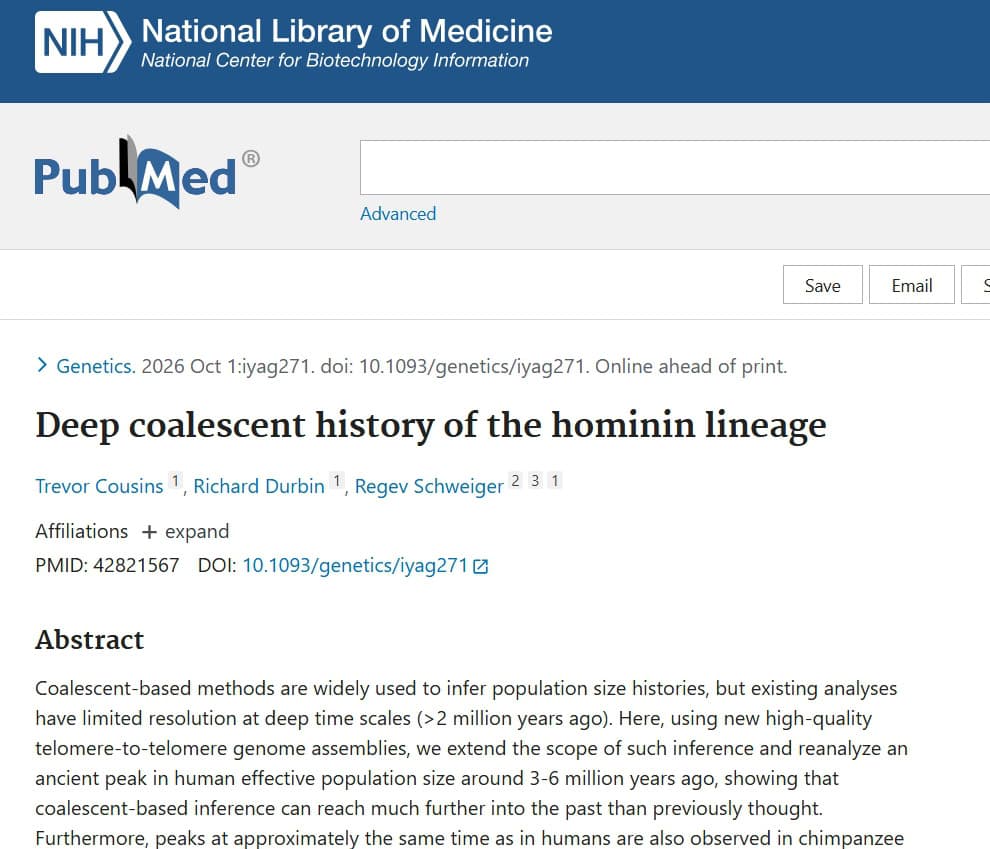 A newly published genetics study, lead author Trevor Cousins, suggests the story may not be quite so simple. Researchers analyzing high-quality genomic data report evidence that ancient demographic signals extend much deeper into the evolutionary past than previously appreciated. The authors argue that these findings may reflect a period of complex population structure surrounding the separation of the Homo and Pan lineages. [academic.oup.com], [pubmed.ncb…lm.nih.gov]
The study, titled Deep coalescent history of the hominin lineage, revisits a long-standing puzzle in evolutionary genetics. Researchers observed an ancient peak in effective population size dating to approximately three to six million years ago. Surprisingly, similar signals appeared in chimpanzees and bonobos, but not in gorillas or orangutans. [academic.oup.com], [pubmed.ncb…lm.nih.gov]
According to the authors, this pattern is difficult to explain using a simple model in which an ancestral population split cleanly into separate species. Instead, they suggest that ancient population structure may provide a more parsimonious explanation. In other words, multiple populations may have existed within the broader ancestral lineage before the final separation of humans and chimpanzees. [academic.oup.com], [pubmed.ncb…lm.nih.gov]
Coalescent-based methods
Importantly, the study does not prove that humans and chimpanzees continued interbreeding after becoming distinct species. Nor does it overthrow the established understanding that humans and chimpanzees ultimately followed separate evolutionary trajectories. What it does suggest is that the process leading to that separation may have been considerably more complicated than the straightforward branching pattern often depicted in textbooks. [academic.oup.com], [pubmed.ncb…lm.nih.gov]
From the Abstract:
 Coalescent-based methods are widely used to infer population size histories, but existing analyses have limited resolution at deep time scales (>2 million years ago). Here, using new high-quality telomere-to-telomere genome assemblies, we extend the scope of such inference and reanalyze an ancient peak in human effective population size around 3-6 million years ago, showing that coalescent-based inference can reach much further into the past than previously thought. Furthermore, peaks at approximately the same time as in humans are also observed in chimpanzee and bonobo, but not in gorilla or orangutans.
We show that this pattern is unlikely to be an artifact of model violations and discuss its potential implications for understanding hominin evolutionary history. It is known that such peaks can arise from ancestral genetic structure, and consequently we suggest that a parsimonious explanation for the contemporaneous peaks in humans, chimpanzees and bonobos would be a period of complex speciation before final separation of Homo from Pan, in contrast to a scenario where these lineages diverge cleanly from a panmictic common ancestor.
Ancient Hominins
The implications for paleoanthropology are fascinating.
The earliest possible hominins, including Sahelanthropus tchadensis, Orrorin tugenensis, and Ardipithecus, have long occupied an uncertain position near the base of the human family tree. Scientists continue to debate exactly how these fossils relate to later human evolution. If the ancestral populations that gave rise to humans and chimpanzees were themselves structured and diverse, it may help explain why some of these early fossils possess a mixture of ape-like and human-like features.The new findings also highlight the growing power of modern genetics. Advances in genome sequencing now allow scientists to investigate events millions of years into the past. As genomic methods improve, researchers are increasingly able to detect signals from periods once considered inaccessible to scientific analysis.
For enthusiasts of human origins, the most exciting aspect of the study may be what it reveals about the nature of evolution itself. Species do not always emerge through neat, clearly defined events. Populations expand, contract, fragment, reconnect, and adapt over enormous spans of time. The transition from our shared ancestor with chimpanzees to the earliest hominins may have been one of those complex evolutionary episodes.
Whether future research confirms or challenges these conclusions remains to be seen. However, the study serves as a reminder that the origins of humanity remain one of science’s greatest unsolved mysteries. The deeper researchers examine ancient genomes, the more intricate the story becomes.
The traditional six-million-year human-chimpanzee split remains a useful framework. Yet this new research suggests that beneath that familiar date may lie a far richer and more complicated evolutionary history, one that is only now beginning to emerge from the genetic evidence.


