
🌴 Homo Floresiensis: A Discovery That Shook the World
In 2003, deep within the Liang Bua cave on Flores Island, archaeologists uncovered fossils of a diminutive hominid species — Homo floresiensis. Standing just 3’6″ tall with primitive features and tiny brains, these “Hobbits” rewrote the story of human evolution.
🧝♂️ The Hobbit Species: Homo Floresiensis
Nicknamed “The Hobbit,” Homo floresiensis displayed traits unlike any known human ancestor. Their skeletal structure suggested a lineage that diverged long before Homo sapiens arrived in the region. The fossils, dating between 100,000 and 60,000 years ago, were announced in Jakarta in 2004 and published in Nature, sparking global fascination.
These individuals had small cranial capacities (around 380 cm³), no chins, receding foreheads, and relatively large feet — features that aligned more closely with early hominins than modern humans. The most complete specimen, LB1, was a female whose anatomy challenged long-held assumptions about brain size and intelligence.
From the Smithsonian:
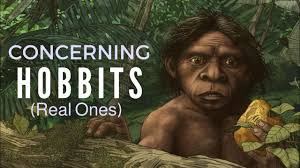 Remains of one of the most recently discovered early human species, Homo floresiensis (nicknamed ‘Hobbit’), have so far only been found on the Island of Flores, Indonesia. The fossils of H. floresiensis date to between about 100,000 and 60,000 years ago, and stone tools made by this species date to between about 190,000 and 50,000 years old.
H. floresiensis individuals stood approximately 3 feet 6 inches tall, had tiny brains, large teeth for their small size, shrugged-forward shoulders, no chins, receding foreheads, and relatively large feet due to their short legs. Despite their small body and brain size, H. floresiensis made and used stone tools, hunted small elephants and large rodents, coped with predators such as giant Komodo dragons, and may have used fire.
🧬 Cryptozoology Meets Paleoanthropology
 Australian cryptozoologist Colin Groves played a pivotal role in confirming the species. His open-minded approach and international reputation helped legitimize the find. The team — including Tom Sutikna, Peter Brown, and Mike Morwood — faced intense media scrutiny, amplified by the whimsical “Hobbit” nickname.
Groves, often called the grandfather of cryptozoology, had previously reclassified key hominid fossils and coined the term Homo ortus. His involvement lent credibility to the Flores discovery and helped it gain swift acceptance in academic circles.
🦎 Flores: Island of Dragons and Secrets
Flores isn’t just home to ancient hominids. It also hosts the Komodo dragon — the world’s largest lizard and a tourism icon. The island’s biodiversity and archaeological richness make it a crucible of evolutionary intrigue.
🧳 The Controversy: Teuku Jacob and the Fossil Heist
Enter Teuku Jacob, Indonesia’s leading paleontologist. A fervent nationalist, Jacob opposed the classification of Homo floresiensis as a new species. He argued the fossils were pygmies with microcephaly — not evolutionary outliers.
In a dramatic twist, Jacob seized the fossils from the dig site and kept them hidden for nearly a year. His actions sparked outrage across the scientific community. Professor Bert Roberts recalled: “Jacob just put them in a suitcase and walked out the door.”
🧠 Sovereignty or Sabotage?
 Was Jacob protecting national pride — or undermining scientific progress? The incident raised questions about ownership, ethics, and the politics of discovery. Paige Madison, a leading expert on Homo floresiensis, documented the fallout and its impact on international collaboration.
Jacob’s resistance wasn’t just scientific — it was symbolic. As a student of Gustaf von Koenigswald and a survivor of Japanese occupation, Jacob saw the fossils as part of Indonesia’s heritage. But his methods — including fossil confiscation and media suppression — cast a long shadow over the discovery.
🧙♂️ Legacy and Recognition
Despite the controversy, Homo floresiensis gained widespread acceptance. Chris Stringer of the Natural History Museum called it a missing branch of the human tree. Bernard Wood of George Washington University hailed it as the most significant discovery of his career.
The find challenged assumptions about human evolution, intelligence, and migration. It suggested that small-bodied hominins could survive in isolated environments long after Homo sapiens arrived — a revelation that continues to reshape paleoanthropology.
Homo floresiensis, the Hobbit, still gives us pause! Those tiny brains and giant feet – a true evolutionary enigma. Cryptozoologist Colin Groves swooped in like a knight in shining armor, lending much-needed credibility to the find amidst the Hobbit hullabaloo. Poor Flores, caught between ancient hominins and giant dragons! The Teuku Jacob saga, however, was the real drama – hijinks and suitcase stowaways! Was it for national pride or just a really bad Tuesday? All in all, a fascinating chapter, proving even our supposed ancestors could stir up quite the international incident!
Whoa! Dude, you know Colin Groves? I’m a big fan of his. I’m impressed. Thank you for visiting our site and I hope you will come back often. Comments approved within 24 hours usually.