Seasonal Hunting Camps – Abstract
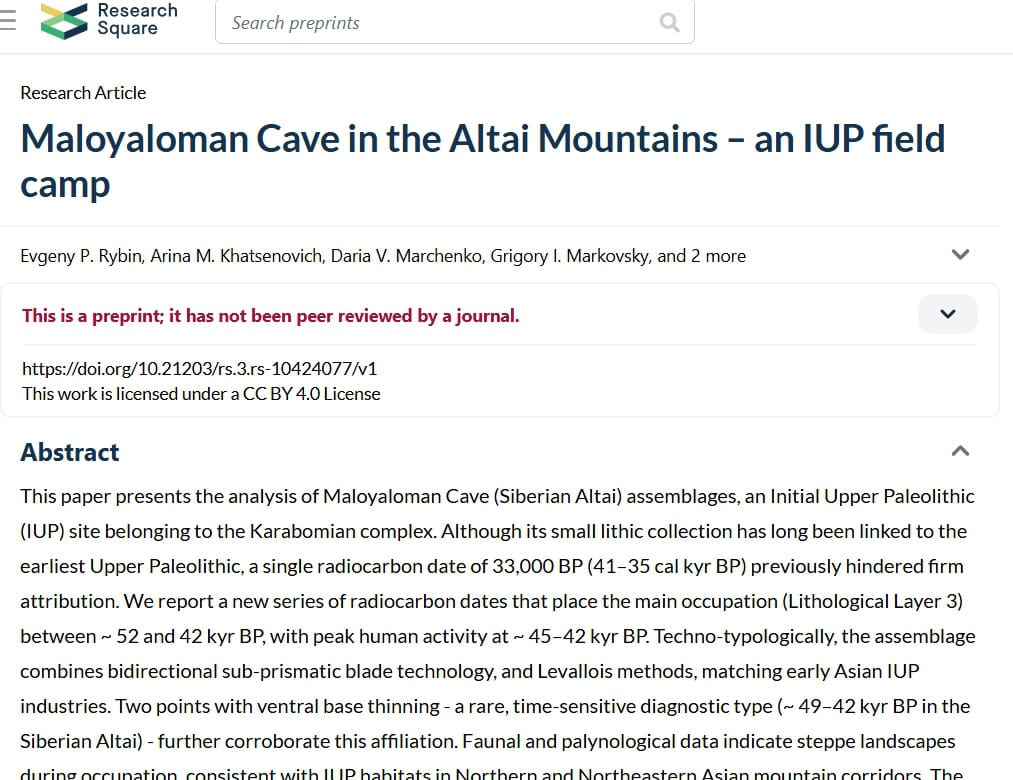
 Recent analysis of the Maloyaloman Cave (Paper here) assemblages in the Altai Mountains provides new insight into the behavioral ecology of early modern humans and late archaic populations in southern Siberia. Radiocarbon dates between 52,000–42,000 BP place the site firmly within the Initial Upper Paleolithic (IUP), aligning it with the broader Kara-Bom / Altai techno‑complex. The authors argue that Maloyaloman Cave functioned as a short‑term hunting field camp, comparable in logistical purpose to modern seasonal hunting cabins. This interpretation is supported by limited accessibility, carnivore traces, a high proportion of finished tools, and the presence of symbolic ornaments.
One of the paper’s senior authors, Anatoly P. Derevianko, co‑discoverer of the Denisovan phalanx from Denisova Cave, situates Malloy Loman within a long Siberian research tradition emphasizing mobility, seasonal provisioning, and blade‑based lithic production systems.
1. Introduction: Seasonal Hunting Camps in Paleolithic Siberia
 Across the Paleolithic world, temporary hunting shelters served as seasonal nerve centers for human survival. These sites were not permanent dwellings but episodic logistical hubs where hunters:
- cached tools
- processed game
- repaired equipment
- sheltered briefly during seasonal rounds
Maloyaloman Cave represents one of the earliest such field camps in the Altai region.
2.1 Location and Geological Setting
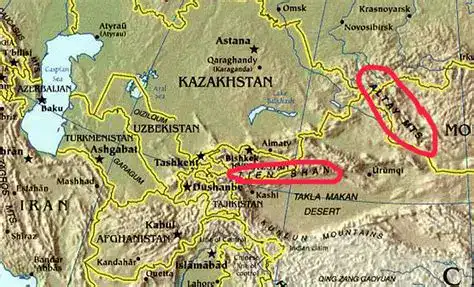
Malloy Loman Cave lies within the Altai massif, a region known for dense Paleolithic occupation, including Denisova Cave, Kara-Bom, Ust-Karakol, and Okladnikov Cave.
 2.2 Radiocarbon Chronology
The authors present a new series of AMS radiocarbon dates:
- 52,000 BP (earliest occupation)
- 42,000 BP (latest occupation)
These dates place Malloy Loman firmly within the Initial Upper Paleolithic, predating earlier estimates (~33 ka) that had obscured its cultural attribution.
2.3 Occupation Characteristics
The cave’s archaeological signature indicates brief, episodic visits:
- limited accessibility
- carnivore use between human visits
- dominance of finished tools rather than production debris
- presence of a symbolic deer‑tooth pendant
These traits collectively support the interpretation of Malloy Loman as a short‑term hunting field camp, not a residential base.
3. Novosibirsk and the Siberian Research Tradition
 The paper’s authors represent a “superstar cast” of Russian Paleolithic researchers centered at Novosibirsk State University, a major hub for Siberian archaeology.
3.1 Novosibirsk’s Scientific Context
Novosibirsk sits adjacent to Akademgorodok, Russia’s “Science City,” historically linked to Cold War research and the Soviet space program. This intellectual environment has long supported high‑level archaeological work in Siberia.
3.2 Key Researchers
The author list includes:
- Anatoly P. Derevianko — co‑discoverer of the Denisovan phalanx
- Aguani Rivian
- Arena Katnovich
- Daria Marenko
Their collective work has shaped modern understanding of the IUP in Central Asia.
 4.1 The Denisovan Discovery
Derevianko’s involvement is significant. His earlier work at Denisova Cave helped identify the famous Denisovan pinky bone, establishing a new archaic hominin lineage.
4.2 Implications for Maloyaloman Cave discovery
Derevianko’s expertise in:
- blade technologies
- symbolic artifacts
- seasonal mobility
- Altai stratigraphy
provides a strong foundation for interpreting Malloy Loman as a logistical hunting camp within a broader IUP behavioral system.
5. Lithic Technology: The Large Blade Techno‑Complex
5.1 Blade Production Systems
The Malloy Loman assemblage includes:
- large blades (~70 mm)
- retouched points
- scrapers
- hide‑processing tools
These tools align with the Altai large-blade techno‑complex, one of the earliest such systems in Eurasia.
5.2 Cultural Attribution
The new radiocarbon dates allow proper attribution of the assemblage to the Initial Upper Paleolithic, resolving earlier confusion caused by the 33 ka misdating.
5.3 Comparative Context
 While Africa developed blade-like technologies earlier, a true large-blade production system appears to have emerged independently in Eurasia during the IUP.
6.1 Description
The site yielded a pendant carved from a deer canine, marked with 11 parallel incisions and drilled for suspension.
6.2 Cultural Significance
Symbolic ornaments indicate:
- identity
- memory
- social belonging
- intergenerational transmission of meaning
These artifacts demonstrate that even short-term hunting camps were embedded within symbolic cultural systems.
7. Interpretation: Maloyaloman as a Short-Term Hunting Field Camp
The authors conclude that Malloy Loman Cave served as:
- a seasonal shelter
- a tool maintenance station
- a resource processing site
- a brief logistical waypoint
This interpretation aligns with ethnographic models of hunter-gatherer mobility and with modern analogs such as seasonal hunting cabins.
8. Conclusion
Malloy Loman Cave provides rare insight into the logistical strategies of early modern humans in southern Siberia. Its combination of:
- short-term occupation
- finished tools
- symbolic ornaments
- large-blade technology
- carnivore interludes
- IUP radiocarbon dates
supports its classification as a temporary hunting field camp.
The involvement of Anatoly Derevianko situates the site within a broader Siberian research tradition that has reshaped our understanding of human evolution, mobility, and cultural innovation in the Altai region.