Kadanuumuu: Still roaming the Jungles of Congo today?
 Kadanuumuu, the “Big Man” of Ethiopia, towers over the fossil record like a forgotten sentinel. Discovered in 2005 and dated to 3.6 million years ago, this Australopithecus afarensis specimen shattered assumptions about early hominin size, gait, and anatomy. Standing nearly 5’7″, Kadanuumuu was no crouching primitive—he walked tall, with a ribcage and limb proportions eerily close to modern humans.
But what if Kadanuumuu never truly vanished?
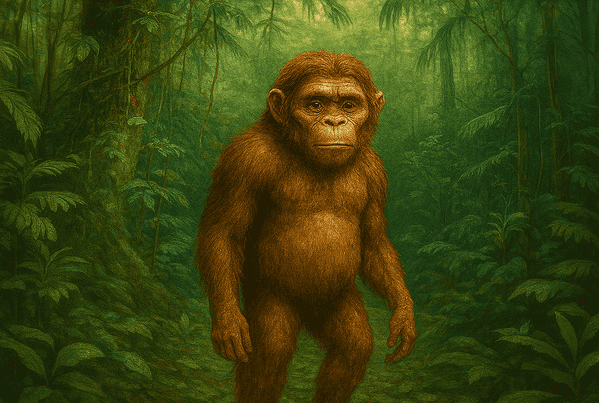
In the dense jungles of Central Africa, particularly the remote regions of the Congo Basin, locals and researchers alike have reported sightings of a mysterious ape-like creature. Known colloquially as the Bili Ape, this cryptid defies classification. It walks upright, builds nests on the ground, and exhibits behaviors that blur the line between chimpanzee and something… other.
Could the Bili Ape be a living echo of Kadanuumuu?
Fossil Shadows and Living Echoes
Mainstream paleoanthropology places Australopithecus afarensis firmly in the past, extinct for millions of years. But the fossil record is notoriously incomplete. Kadanuumuu himself was a surprise—a skeleton so complete and so large that it forced a rethinking of Lucy’s dominance in the hominin narrative.
If one giant Australopithecine could remain hidden in the sediment for millennia, could another survive in the canopy?
The Bili Ape’s reported height, upright posture, and skull morphology have sparked fringe theories suggesting it may represent a relic population of archaic hominins. While DNA analysis has linked it to the common chimpanzee (Pan troglodytes), behavioral anomalies persist. Some researchers have noted its uncanny ability to mimic human gestures, its lack of fear toward humans, and its haunting vocalizations.
Myth, Memory, and Evolutionary Drift

Yohannes Haile-Selassie
Kadanuumuu’s name means “Big Man” in the Afar language—a fitting title for a creature that challenges the small-bodied stereotype of early hominins. In the Congo, the Bili Ape is known by many names, often whispered with reverence or fear. These linguistic echoes suggest a deeper cultural memory, one that may preserve fragments of encounters with something ancient.
The fossils were discovered by Yohannes Haile-Selassie, PhD at the Cleveland Natural History Museum and a colleague of Lucy Discoverer Donald Johanson.
Could these stories be mythologized memories of a species that never fully disappeared?
Evolution doesn’t always move in straight lines. Isolated populations can drift, adapt, and survive in ecological niches that defy extinction. The Congo Basin, with its vast unexplored territories, remains one of the last frontiers where such evolutionary ghosts might linger.
Discovering the “El Dorado of paleoanthropology”
From NBC News, 2010,
Lucy’s ‘great-grandfather’ found
 Arizona State University paleoanthropologist Donald Johanson, who discovered Lucy back in 1974, said the latest discovery adds to a “treasure trove” of hundreds of australopith fossils from East Africa. “It’s like the El Dorado of paleoanthropology,” he told me. Piecing together the evidenceThe first bone of Kadanuumuu’s skeleton was found in 2005 in the Woranso-Mille area of the Afar region, about 30 miles north of where Lucy was discovered.
Kadanuumuu Reimagined
In our latest video, we explore this tantalizing possibility—not as a claim of fact, but as a mythic inquiry. We thread together fossil evidence, eyewitness accounts, and evolutionary speculation to ask…
What if Kadanuumuu never died? What if he adapted, migrated, and became the legend we now call the Bili Ape?
This isn’t just a story about bones and jungles. It’s about the stories we tell to make sense of our origins. It’s about the tension between academic orthodoxy and the wild unknown. And it’s about the possibility that the past isn’t buried—it’s watching us from the trees.
Join the Inquiry
Watch the full video on our YouTube channel and decide for yourself. Is Kadanuumuu extinct—or simply waiting to be rediscovered? 🔗 [Watch now] 🔗 [Support the mythic archive on BuyMeACoffee] 🔗 [Explore more mythic articles on Subspeciest.com]