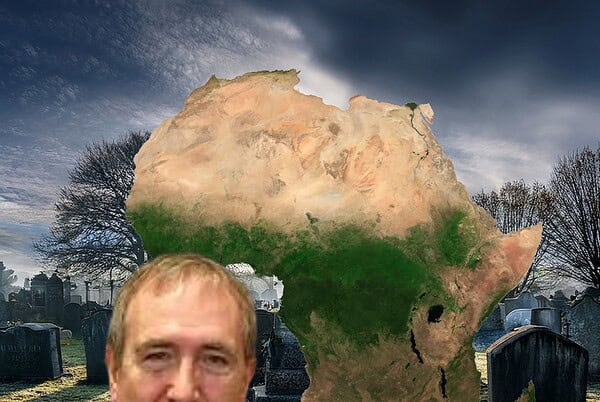
Ghost Lineage Corridor from Cameroon to the Congo
ACTION ALERT! Major brands and top corporations are now advertising on our documentaries at YouTube. We appreciate you visiting our website — truly. But a click on the video above, and a like, helps us grow far more than reading this page ever could. Please click now and support the mission.
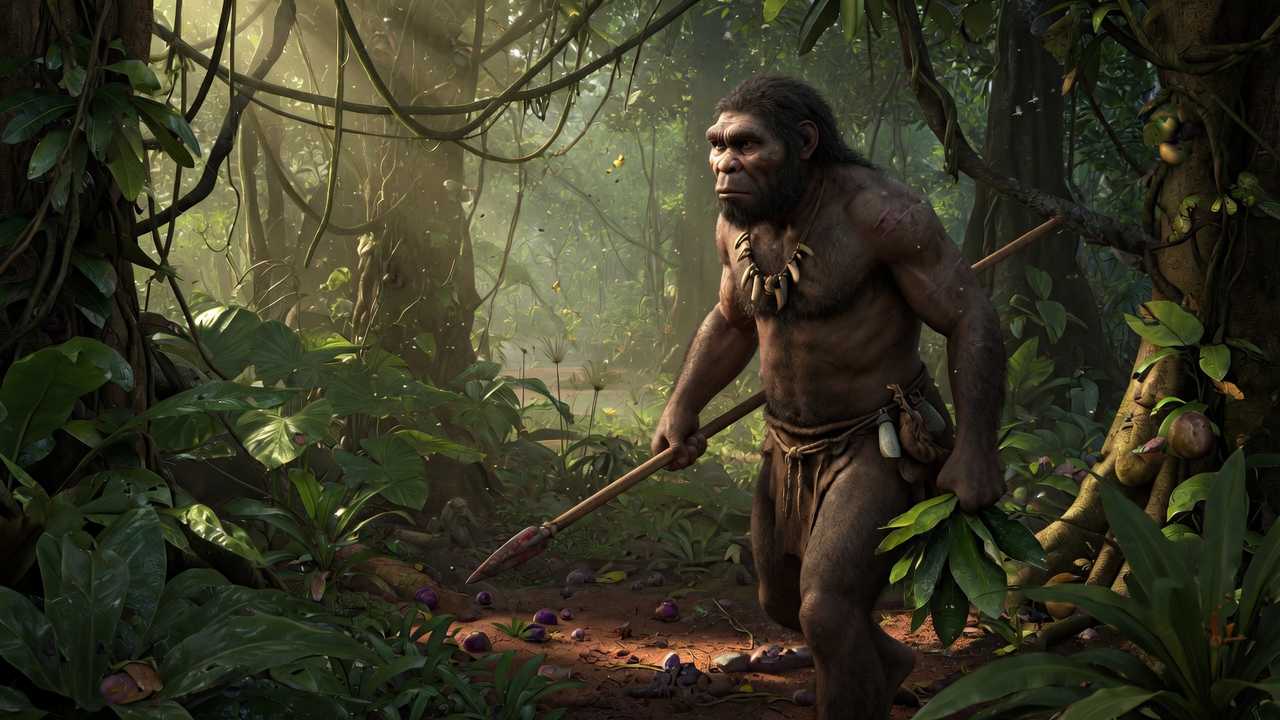 In 2025, a Nature paper on the Anyama–Bété I site in Côte d’Ivoire quietly reopened one of the most persistent mysteries in African prehistory. The study reported stone tools from deep layers dated to ~150,000 years ago, but these artifacts were not Acheulean, not Levallois, and not Middle Stone Age. Instead, they were simple flakes and cores, technologically more primitive than what Homo sapiens were producing at the same time elsewhere in Africa.
The authors described a clear association between Late Middle Pleistocene material culture and a wet tropical forest environment in southern Côte d’Ivoire — a region of present‑day rainforest. The Bété I assemblage, in other words, did not look like the handiwork of early modern humans. It looked like relic technology.
This finding revived an older puzzle. In the late 1980s, Russian archaeologists excavating the same region reported unusually simple stone tools in the upper layers of Bété I. Early radiocarbon attempts tentatively placed these artifacts in the Late Pleistocene, far younger than expected for such primitive technology. These results were never fully published or confirmed, but they lingered in the background of West African archaeology as an unresolved anomaly.
The 2025 Nature study redated the deeper layers to 150 ka but did not address the earlier claims of unexpectedly late simple tools. Yet the new team did acknowledge the original excavators, and according to a University of Liverpool report, surviving members of the 1980s project helped relocate the Bété I site. The implication is subtle but important: the technological simplicity at Bété I has been observed twice, by two different research generations, under two different methodological regimes.
This raises a provocative possibility — that the West African rainforest may have sheltered late‑surviving archaic populations whose material culture remained conservative long after modern humans had adopted more complex technologies elsewhere.
Iwo Eleru and Ishango: Fossils at the Edges of the Family Tree
 A skull in Nigeria. A tooth in Congo. Two sites separated by thousands of miles and tens of thousands of years — yet both whisper the same unsettling possibility.
At Iwo Eleru, a ~13,000‑year‑old skeleton exhibits cranial features that are unexpectedly archaic for such a young date. At Ishango, a 30,000‑year‑old molar was described by Shara Bailey and Bernard Wood (2014) as “Australopithecus‑like” in several key morphological traits. Their paper was published in 2014. For decades, these finds were treated as outliers, errors, or statistical noise.
But taken together — and placed alongside the Bété I lithics — they point toward a deeper mystery hidden within Africa’s last great rainforest belt.
Genetic Echoes: Durvasula & Sankararaman’s Ghost Population

Sriram Sankararaman
In 2020, Arun Durvasula and Sriram Sankararaman published a landmark study identifying signals of admixture in West African genomes from a deeply divergent archaic population. This lineage split from the ancestors of modern humans hundreds of thousands of years ago, persisted into the Late Pleistocene, and contributed 2–19% of the ancestry of some present‑day West African groups.
Crucially, the genetic signal does not match Neanderthals or Denisovans. It represents something else — something older, something local, something that may have survived in ecological refugia such as the Congo Basin and the Upper Guinean rainforest.
This aligns uncannily with the archaeological anomalies at Bété I, Iwo Eleru, and Ishango.
Much of Sankararaman’s remarks talking specifically about the identification of the ghost species from 2020 in YouTube videos have been mysteriously scrubbed.
Côte d’Ivoire to the Congo Basin
From Côte d’Ivoire to the Congo Basin stretches what might be called a Corridor for the Ghost Lineage — a hidden highway through deep time. Within this belt:
- Primitive tools at 150,000 years
- An archaic‑looking skull at 13,000 years
- An Australopithecus‑like tooth at 30,000 years
- A genetic signal from a deeply divergent archaic population
All point toward the same conclusion: an unknown hominin lineage may have persisted in Africa’s rainforests far longer than once believed.
We do not yet know which archaic population left the signal — only that it was real, persistent, and present in Late Pleistocene Africa. With new field techniques, proteomics, and sediment DNA recovery, additional evidence may soon emerge from the tropical forests that have long concealed Africa’s most elusive ancestors.