Worknesh Degefa
Kenyan and Ethiopia runners “Something to behold. An athletic achievement that demanded appreciation” — Boston.com
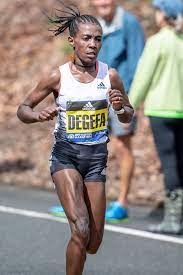 The winners for the 123rd annual Boston Marathon were Ethiopian Worknesh Degefa and Lawrence Cherono.
Defega was quoted at Boston.com:
“I knew I have some speed, so I pushed myself at five miles,’’ she said through a translator. “I knew at 35 kilometers that I was going to win.’’
The 2nd place finisher in the woman’s division was the 2017 winner, Kenyan Edna Kiplagat.
For the upcoming Yellow River Marathon in China, IAAF reports April 19:
Waganesh Mekasha is a serious title contender and arguably the most in-form woman on the entry list. The rising Ethiopian achieved a big personal best of 2:22:45 to finish fourth at Dubai Marathon in January.
From nyrr.org:
Worknesh Degefa is the Ethiopian record holder in the marathon and the 2019 Boston Marathon champion. Defega won her Boston Marathon debut after running away from the lead pack early and then holding off Kenya’s Edna Kiplagat through the final miles. She had a nearly three-minute lead over her chasers at one point in what was just her fourth career marathon.
Degefa has run the Dubai Marathon three times, and in 2019 she set the national record of 2:17:41 there, becoming the fourth-fastest female marathoner in history. She won her marathon debut in Dubai in 2017.
Kenyans and Ethiopians always top long distance runners
All the top contenders, including Cheptanui Kilel and Agnes Kirop are from Kenya or Ethiopia.
As explained in TheConversation.com, 2016:
Many of the elite Kenyan and Ethiopian distance runners were born and raised at altitudes of around 2,000-2,500 metres. This may lead to superior levels of hemoglobin (a protein in red blood cells that carries oxygen throughout the body) and hematocrit (the volume of red blood cells in the blood). In turn, this leads to an increased ability to transport oxygen to the working muscles.
Long‑distance running at the elite level is shaped by a combination of physiology, training methodology, and race‑day strategy. Marathon athletes typically follow multi‑year development cycles that include high‑mileage base periods, altitude training camps, and carefully structured tapering phases before major competitions. Coaches emphasize aerobic efficiency, lactate‑threshold development, and consistent weekly volume, often exceeding 100 miles per week for top competitors.
Modern marathon preparation also incorporates sports science tools such as GPS‑based pacing analysis, heart‑rate monitoring, and individualized nutrition plans. Athletes work closely with physiotherapists and biomechanical specialists to reduce injury risk and maintain running economy. Hydration, carbohydrate intake, and heat‑management strategies have become increasingly important as more major races take place in warm or humid environments.
International marathon events—from Boston and London to Dubai, Tokyo, and Berlin—attract deep fields of professional runners each year. These races serve as both competitive arenas and testing grounds for new training approaches, shoe technologies, and pacing tactics. The introduction of advanced racing shoes with carbon plates and energy‑return foams has reshaped performance expectations across the sport, contributing to a wave of record‑setting times in the past decade.
Race strategy remains a decisive factor. Some athletes prefer to surge early and build a commanding lead, while others rely on even pacing or negative splits to conserve energy for the final kilometers. Weather conditions, course elevation profiles, and the presence of pacemakers all influence how a race unfolds. Regardless of approach, marathon success requires a blend of endurance, mental resilience, and precise execution.
As global interest in distance running continues to grow, elite marathoners remain central figures in the sport, inspiring recreational runners and contributing to the ongoing evolution of competitive endurance athletics.
Video (cover photo) on Kenyan long distance training at YouTube.
Cyclist and trail runner Thomas Corvazier April 19, adds:
For sport this is almost entirely wrong, even excluding age. Genetics will do half of it, most of us will never run 100m in less than 11'', marathon in sub 2h30 or ironman sub 9h, no matter how strong is eagerness.
— Thomas Corvazier (@tcorvazier) January 30, 2019