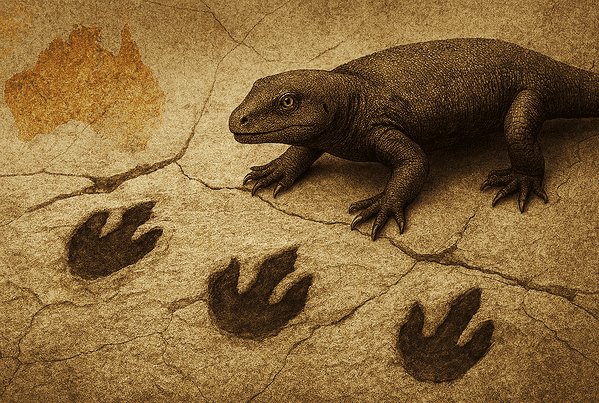
Masripithecus changes the Phylogenetic tree for Human Origins
 In late March 2026, a quiet announcement from Mansoura University began circulating through paleoanthropology circles. It came from Dr. Hesham Sallam and his research team — the same group behind several major Egyptian fossil discoveries over the past decade. Their new find, Masripithecus moghraensis, is already reshaping how scientists understand the origins and early dispersal of the great apes.
The species name itself anchors the discovery: Masripithecus, “the Egyptian ape,” referencing Wadi Moghra, a fossil‑rich locality in northern Egypt. It was here, during fieldwork in 2023 and 2024, that members of the Sallam Lab brushed away the desert sand and uncovered the tiny remains of an early primate — a creature that lived between 16 and 18 million years ago, deep in the Middle Miocene.
Here is the link to the paper in Science, (Not open access.)
Dr. Sallam summarized the significance succinctly:
“We spent five years searching for this kind of fossil because when we look closely at the early ape family tree, it becomes clear that something is missing — and North Africa holds that missing piece.”
For decades, paleoanthropology textbooks have placed the cradle of early apes squarely in East Africa. Kenya and Uganda preserve a rich record of Miocene hominoids from 20 to 10 million years ago. But the earliest branching events — the moment when the ancestors of gibbons, orangutans, gorillas, chimpanzees, and humans first diverged — have remained frustratingly obscure.
Masripithecus now enters that gap.
A Fossil at the Crossroads of Continents
 The Wadi Moghra site is not simply “northeastern Africa.” It sits at the Afro‑Arabian–Levantine hinge, the narrow ecological corridor where Africa opens into Eurasia through the Sinai land bridge. In the Middle Miocene, this region was not a political boundary but a continuous environmental theater stretching from the Nile Delta through the Levant and into the Balkans.
This is the landscape Masripithecus inhabited — a world before Africa and Eurasia became biogeographically distinct.
The research team behind the discovery included both Egyptian and American scientists, among them Natural History Museum mammalogy researcher Dr. Eric R. Seiffert, who emphasized the broader implications:
“Our study is sure to reignite debate about the ancient geography of early hominoids.”
And it already has. In an April 2026 briefing, the London Natural History Museum noted that Hominoidea — the group containing all apes and humans — may have originated not in East Africa, but in the northeastern corner of Afro‑Arabia, precisely where Masripithecus was found.
A New Model of Ape Dispersal
 The discovery forces a re‑evaluation of how early apes moved across continents. It could possibly even signal the origins of Apes in southern Europe in the Mediterranean region.
East Africa preserves a strong fossil record up to about 10 million years ago, but the question has always lingered: How did apes reach Eurasia? And just as importantly: Did any Eurasian lineages return to Africa?
Masripithecus provides a new anchor point.
The emerging pattern suggests:
- Early apes radiated northward through the Arabian corridor into Eurasia.
- Some lineages continued into Anatolia and the Balkans, producing species such as Anadoluvius, Ouranopithecus, and Graecopithecus.
- One lineage appears to have returned to Africa, becoming the ancestor of gorillas and chimpanzees.
- Another branch in East Africa eventually produced the earliest known hominins: Sahelanthropus tchadensis, Orrorin tugenensis, and the Ardipithecus group.
This two‑way traffic — out of Africa, into Eurasia, and back again — is now a serious contender for explaining the tangled early history of the great apes.
Why Masripithecus Matters
 Masripithecus is not a celebrity fossil. It is small, fragmentary, and easy to overlook. But its location, age, and phylogenetic position make it one of the most important primate finds of the decade.
It sits:
- near the base of the crown ape lineage,
- at the gateway between continents,
- in a region long suspected but never confirmed as a cradle of early hominoids.
In other words:
Masripithecus lived at the doorway. Everything that came after had to pass through that doorway.
As more fossils emerge from Wadi Moghra and the surrounding region, the early chapters of ape evolution — once thought to be confined to East Africa — may need to be rewritten to include the northern edge of Afro‑Arabia as a central stage.
With the recent Graecopithecus femur find at Azmaka in Bulgaria together with the Trachilos footprints in Greece dated to 6mya, this puts an entirely new light on early human origins.