What If Everything You’ve Been Told About the First Americans Is Wrong?
 For decades, the story of the first Americans has been presented as settled fact. Textbooks, documentaries, and museum exhibit all echo the same refrain: Siberian hunters crossed the Bering land bridge around 14,000 years ago, spreading southward to populate the continent. This “Clovis‑First” dogma has dominated archaeology throughout the 20th century.
But what if the truth is far stranger — and far older?
What if the First Americans actually came from Europe?
The Solutrean Hypothesis: An Alternative Trail
 A small cadre of pioneering archaeologists has long argued that Europeans may have reached North America as early as 23,000 years ago. Known as the Solutrean hypothesis, this theory proposes that Ice Age Europeans traversed the frozen Atlantic during the peak of glaciation, carrying with them a distinctive stone‑tool technology.
The Solutreans were master flintknappers. Their spear points, shaped with overshot flaking and razor‑edge symmetry, are considered among the finest of the Paleolithic. Originating in France between 25,000 and 19,000 years ago, these tools bear uncanny resemblance to artifacts unearthed on the American East Coast. Coincidence? Or evidence of a transatlantic migration long before Columbus?
The Cinmar Discovery: A Blade and a Skull
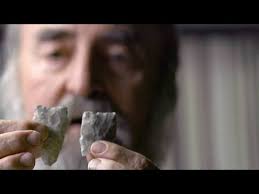
 In 1974, a scallop trawler dredging off the Delmarva Peninsula pulled up a mastodon skull alongside a biface spear point. The site lay nearly 50 feet beneath the Atlantic, preserved in bog sediments for millennia. The blade was later dated to 20,000 years ago — thousands of years older than any previously known tool in the Americas.
The find, known as the Cinmar site, languished in obscurity until archaeologist Darrin Lowery stumbled upon the artifact in a dusty museum case. He alerted Smithsonian curator Dennis Stanford, author of Across the Atlantic Ice, who, along with Solutrean expert Bruce Bradley, confirmed its significance. Together, they unveiled the spear point to the public in 2014, sparking international media coverage and a BBC documentary series.
Resistance and Suppression
Yet the reaction from the academic establishment was swift and hostile. Clovis‑First defenders dismissed the evidence, branding it pseudo‑archaeology. Critics like Dr. Jennifer Raff of the University of Kansas attacked the Solutrean hypothesis as racially charged, accusing its supporters of undermining Indigenous narratives.
The backlash was not merely intellectual. Stanford and Bradley faced professional marginalization, while alternative sites and artifacts were often ignored or buried in museum storage. The mystery deepened when Captain Thurston, who had dredged up the Cinmar blade, died suddenly — followed years later by Stanford himself. To supporters, these deaths symbolized the risks of challenging entrenched paradigms.
A Trail of Inconvenient Evidence
 Despite resistance, the evidence continues to mount:
- White Sands footprints in New Mexico, redated to 23,000 years ago, push human presence in the Americas well before Clovis.
- DNA breadcrumbs from a 24,000‑year‑old Siberian boy reveal genetic ties to both Native Americans and Western Eurasians.
- Stone tools and cut marks across the continent suggest human activity as far back as 25,000 years ago.
Together, these findings point not westward across the Bering Strait, but eastward across the Atlantic.
Why Keep It Under Wraps?
The question remains: why does the establishment resist this narrative so fiercely? Is it fear of rewriting textbooks, of undermining decades of consensus, or of confronting uncomfortable truths about human migration? The deaths of key figures like Stanford and Captain Thurst add a chilling undertone, fueling speculation that the Solutrean story is being deliberately suppressed.
Conclusion: A Mystery That Refuses to Die
The Solutrean hypothesis may never win mainstream acceptance, but its allure lies in the mystery. From a blade dredged beneath the Atlantic to footprints in White Sands, the trail of inconvenient artifacts refuses to vanish. Each discovery whispers across 20,000 years, challenging us to reconsider what we thought we knew.
Perhaps the first Americans were not Siberians crossing from the west — but Europeans braving the ice from the east. If so, history itself must be rewritten.