Flores Hobbits sightings across the Indonesian Island Chain
 For more than a century, the island of Flores has guarded one of the most astonishing chapters in human evolution. Long before modern humans ever reached this remote corner of Indonesia, the island was home to earlier hominins — first Homo erectus, and later the small‑bodied, small‑brained species now known as Homo floresiensis.
The archaeological record on Flores hints at a lineage that endured far longer — and far stranger — than anyone expected. Stone tools on the island date back more than a million years, suggesting that early Homo erectus somehow crossed deep‑water channels to reach Flores long before modern humans mastered seafaring. Over hundreds of thousands of years, isolation and ecological pressures shaped their descendants into something entirely unique: a hominin barely over a meter tall, with a brain roughly the size of a chimpanzee’s, yet capable of making stone tools and hunting pygmy elephants.
Homo floresiensis discovery
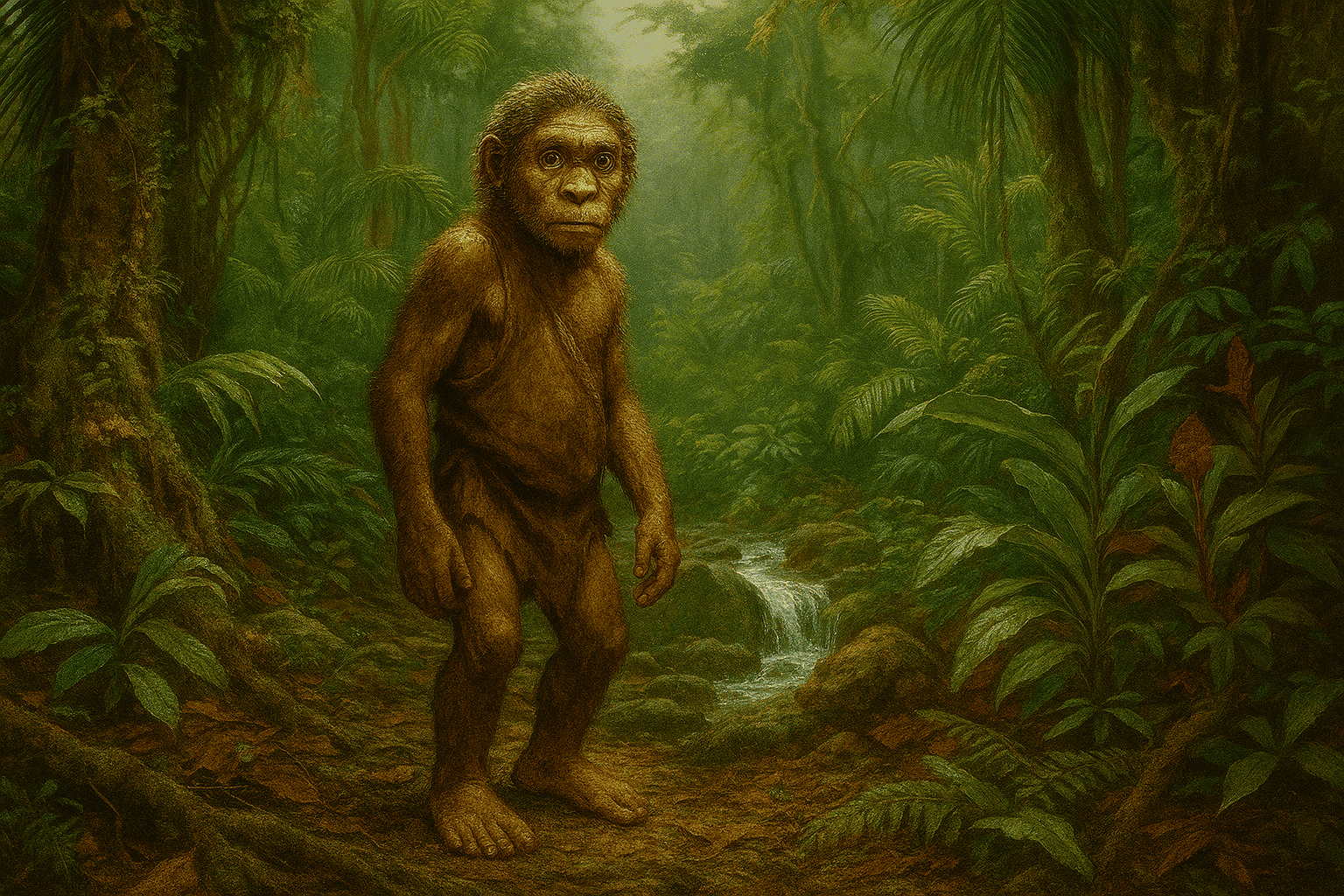 When the remains of Homo floresiensis were first uncovered in Liang Bua cave in 2003, the discovery stunned the scientific world. The Smithsonian Institution describes the species as “unlike any other member of the human family,” combining primitive traits with surprisingly advanced behaviors. Their survival until at least 50,000 years ago places them squarely within the timeframe of modern human expansion — raising the possibility that our ancestors may have encountered them face‑to‑face.
But the fossils are only half the story.
Across Flores and neighboring islands, local traditions speak of small, elusive forest‑dwellers who survived into living memory. Villagers describe them as shy, quick, and human‑like — accounts that bear uncanny similarity to the ancient bones unearthed in Liang Bua.
These stories, combined with the island’s extreme ecological pressures and the remarkable continuity in skeletal traits, raise a provocative question: did the Flores “hobbits” truly vanish, or did some remnant population persist far longer than science has yet confirmed?
 Recent genetic research has added new layers to this mystery. In studies of the Ramapasan villagers of Flores, researchers found that a tiny portion of their DNA could not be matched to modern humans, Neanderthals, or Denisovans. As science writer Carl Zimmer noted, this unclassified fragment hints at a deeper, more complex population history in Island Southeast Asia.
Papuans
This finding aligns with work by Professor Murray Cox of New Zealand, whose research on Papuan genomes revealed multiple deeply divergent Denisovan‑like ancestries. Cox identified stretches of DNA inconsistent with a single interbreeding event, suggesting at least two ancient introgressions dating back more than 350,000 years. He has even proposed that one of these lineages may not be Denisovan at all, but a yet‑to‑be‑identified archaic hominin — a possibility that resonates strongly with the Flores story.
Cox’s findings have been largely ignored perhaps due to the ramifications of his finds. If Papuans are hybridized with Denisovans or Homo erectus, are they a living relict species of hominins?
Orang Pendek, Ebu Gogo and other Strange Creatures deep in the Jungle
 Folklore from across the region adds further intrigue. For decades, eyewitnesses have reported sightings of small, human‑like creatures in the jungles of Sumatra and Borneo — the so‑called Orang Pendek. These accounts have come from explorers, kayakers, pilots, and even motorcycle riders. One of the most famous incidents occurred in 2002, when three motocross riders claimed to have encountered a small, upright figure darting across a trail in Sumatra.
Skeptics dismissed such stories for generations. Yet in 2018, the Tapanuli orangutan — a great ape long known to local villagers but ignored by officials — was formally recognized as a distinct species. If a population of orangutans could remain hidden until the 21st century, what else might still be out there?
This question echoes the legacy of Alfred Russel Wallace, the visionary naturalist who first mapped the boundary dividing Asian and Australasian species. Wallace could never have imagined the deeper truth: that this ancient divide helped shape multiple hominin lineages across the islands east of Java, including the enigmatic “hobbits” of Flores.
Today, the mystery remains open. The fossils tell one story. The genetics tell another. And the legends — persistent, detailed, and strangely consistent — whisper that a branch of the human family tree may have survived in the shadows far longer than we ever believed.
Whatever the truth, Flores continues to challenge our assumptions about human evolution. And as new discoveries emerge from the caves and jungles of Indonesia, the island’s secrets grow only more compelling.