🧬 Neanderthal DNA and Modern Health: The Ghosts We Carry
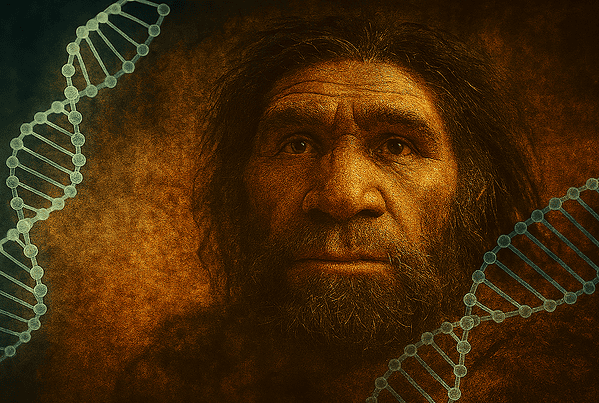
 Neanderthal genes didn’t vanish—they mutated into migraines, skin tone, and Viking hand disease. If you’re European, chances are you’re walking around with a molecular inheritance that’s more caveman than you’d like to admit. And no, it’s not just “2 to 4%.” Some individuals carry up to 6% Neanderthal DNA, and the effects are anything but subtle.
🧠 Pain Sensitivity: The Ancient Nerve Curse
Modern Europeans often show heightened sensitivity to pain. Coincidence? Not likely. Neanderthal variants in the SCN9A gene—which regulates nerve signals—have been linked to increased pain perception. That’s not just a quirk. It’s a neurological echo from Ice Age interbreeding, a reminder that survival once meant feeling everything.
🧬 BNC2 and the Pale Skin Legacy
 Let’s talk pigmentation. The BNC2 gene, inherited from Neanderthals, plays a role in skin tone and tanning response. Europeans with certain Neanderthal alleles show lighter skin and reduced UV protection—a trade-off that made sense in cloudy Ice Age Europe, but now just means more sunburns and dermatology bills.
Neanderthal-human sex bred light skins and infertility
Neanderthals lived in Europe and Asia between about 200,000 and 30,000 years ago. Our species – sometimes dubbed “modern humans” – made it to Eurasia about 65,000 years ago, and so the two species had plenty of time to cosy up. In 2010, geneticists discovered that they had been very close neighbours indeed. They sequenced a Neanderthal genome and discovered it carried genes that also appear in the genomes of people of European and Asian descent: our species must have interbred with Neanderthals.
Neanderthal Genes “punch above their weight” in European traits
Additionally,
 While Neanderthal DNA may make up only 1.6 to 1.8 per cent of the Eurasian genome, it punches above its weight in terms of biological impact, says Reich (Nature, DOI: 10.1038/nature12961).
Joshua Akey and Ben Vernot of the University of Washington in Seattle have analysed the Neanderthal DNA in a further 665 humans (Science, DOI: 10.1126/science.1245938). Both their study and the Harvard one found a hotspot of Neanderthal ancestry in genes relating to keratin, a fibrous protein found in our hair, skin and nails.
One of the genes, BNC2, is involved in skin pigmentation. That implies that Eurasians owe their paler skins partly to Neanderthals. Light skin is an advantage at higher latitudes because it is more efficient at generating vitamin D from sunlight, so Neanderthal DNA may have helped modern humans to adapt to life outside Africa.
🖐️ Viking Hand Disease: A Neanderthal Signature?
 Ever heard of Dupuytren’s contracture—aka Viking Hand? It’s a condition where fingers curl inward, often seen in Scandinavian populations. Recent studies suggest a Neanderthal origin, with genetic markers passed down through admixture. It’s not just folklore—it’s paleo-pathology with a mythic twist.
Key takeaway: The Viking grip wasn’t forged in fjords—it was inherited from Neanderthal knuckle-draggers.
Mysterious ‘Viking disease’ linked to Neanderthal DNA
Neanderthal genes may be one cause of the disorder nicknamed the “Viking disease,” in which fingers become frozen in a bent position, a new study finds.
The study, published June 14 in the journal Molecular Biology and Evolution, finds gene variants that were inherited from Neanderthals that dramatically increase the odds of developing the condition, officially called Dupuytren’s disease.,
🧬 Neanderthal Admixture: More Than Just a Percentage
 Forget the sanitized “2 to 4%” statistic. That’s academic hedging. Some individuals carry up to 6% Neanderthal DNA, and it shows—in facial structure, immune response, even behavior. Celebrities with pronounced brow ridges, wide nasal bridges, and deep-set eyes often echo Neanderthal traits more than they realize.
Steve Wozniak of Apple, Actor Ron Pearlman, and many European Soccer stars such as Sebastian Cheval, have striking Neanderthal features.
🧠 Why This Matters: The Mythic Pulse Beneath the Genome
This isn’t just about genetics. It’s about identity, inheritance, and the mythic tension between past and present. Neanderthal DNA isn’t a relic—it’s a living archive. Every sunburn, every nerve flare, every curled finger is a reminder that we are not purely modern. We are hybrids. We are haunted.
Bold takeaway: You don’t “descend” from Neanderthals. You carry them. In your blood. In your bones. In your pain.