
James Watson: The Double Helix Maverick And “libertarian” Who Refused to Bow down to the Woke
 James Watson, born April 6, 1928, remains one of the most polarizing figures in modern science. Co-discoverer of the DNA double helix alongside Francis Crick, Watson didn’t just help decode life—he embodied the messy, brilliant, and often uncomfortable reality of scientific progress.
Watson was 97.
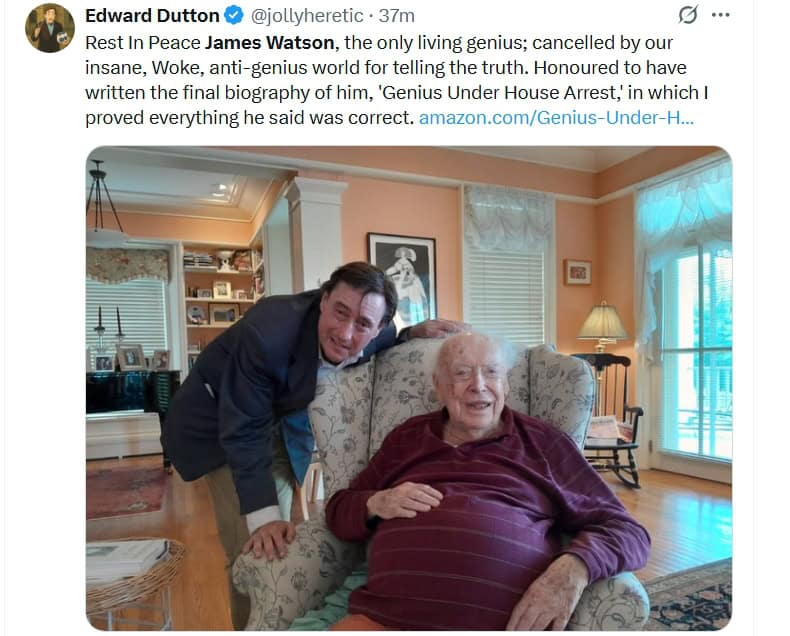
Watson’s longtime friend Edward Dutton of the Jolly Heretic made the announcement of his death on Twitter, early Friday morning, November 7, 2025.
Edward Dutton is a friend of this site and was an advisor in our early days when we launched – subspecieist.com
Watson’s legacy is cemented in the 1953 Nature paper that changed biology forever. But unlike the sanitized heroes of textbook lore, Watson was never content to play nice. He was brash, unapologetic, and fiercely competitive.
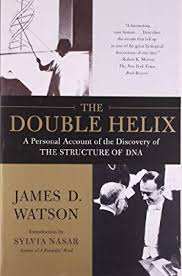
His memoir The Double Helix reads more like a Cold War thriller than a lab diary—complete with gossip, ambition, and intellectual espionage.
The Man Who Wouldn’t Bow to Woke Orthodoxy
Watson, Reason Interview, 2023:
Watson: Well, my sensibility is very libertarian.
In an era where scientists are expected to be PR-friendly and politically correct, Watson stood apart. He made controversial statements—some indefensible, others merely inconvenient truths—and paid the price. Stripped of honorary titles and publicly shamed, Watson became a cautionary tale for young researchers: brilliant, but too blunt.
In 2019, as we were the first to report here at Subspecieist.com, Dr. Watson was stripped of his titles and honorary degrees for expressing concern that Americans of African Ethnicity could not keep up with White students and in the corporate world due to lower IQ levels.
Nobel Prize-winning molecular biologist James Watson has been stripped of honorary titles awarded to him by Cold Spring Harbor Laboratory (CSHL), a Long Island-based non-profit research institution long linked with the scientist. The decision follows the latest episode in Watson’s decades-long pattern of racist (sic) remarks.
Note – the Smithsonian displays ignorance in describing his views as “racist,” rather than race realist. Other media followed suit after a slanderous Scientific American story on Watson.
 Yet the irony is rich. The same institutions that canceled him still teach his discoveries. The same media that vilified him still cite his work. Watson’s scientific contributions are immortal; his social sins, endlessly debated.
Via the BBC:
Watson: “all our social policies are based on the fact that their intelligence is the same as ours – whereas all the testing says not really”.
Beyond the Double Helix
Watson directed Cold Spring Harbor Laboratory for decades, transforming it into a powerhouse of molecular biology. He helped launch the Human Genome Project. He mentored generations of scientists. And yes, he said things that made people uncomfortable. But science isn’t comfort—it’s confrontation with the unknown.
Watson’s critics often forget that he was a product of his time, but also a disruptor of it. He didn’t just ride the wave of discovery—he helped create it. And he never asked for permission.
From Amazon.com, about his autobiography:
The classic personal account of Watson and Crick’s groundbreaking discovery of the structure of DNA, now with an introduction by Sylvia Nasar, author of A Beautiful Mind.
By identifying the structure of DNA, the molecule of life, Francis Crick and James Watson revolutionized biochemistry and won themselves a Nobel Prize. At the time, Watson was only twenty-four, a young scientist hungry to make his mark. His uncompromisingly honest account of the heady days of their thrilling sprint against other world-class researchers to solve one of science’s greatest mysteries gives a dazzlingly clear picture of a world of brilliant scientists with great gifts, very human ambitions, and bitter rivalries.
Dr. Doudna praises Dr. Watson
In a twist of irony, then rising star geneticist Dr. Jennifer Doudna, co-discover of CRISPR technology, suggested in a speech that James Watson had inspired her into the field of genetics.
CARTA Speech, 2019 via YouTube:
 My Dad was a professor of literature at the University of Hawaii. And he read a lot of books. He wasn’t a scientist, but he liked a lot of science books. One day I came from home and I saw this in my room. This was really one of the first books that I read about science. And if you’ve read Jim Watson’s book The Double Helix, you know it’s a story of the discovery of the structure of DNA. But it’s also a story of the very human aspects of doing science. And I still remember being incredibly surprised to read this book.
You know I was used to reading kind of dry textbook descriptions of science. And this book for the first time made it seem like kind of a very human endeavor, with, ya know peoples’ foibles and sort of the process of discovery being described in a way that I hadn’t been able to imagine before. So, this really captivated me and I would say in no small way contributed to my interest in applying the study of chemistry to biological systems.
Editor’s note – Developing… This story will be updated later this afternoon.
Update!
The Scientific American couldn’t resist in taking one last jab at Watson now that he’s dead. In their Obit:
His legacy was complicated by repeated racist remarks that linked race and intelligence. Those statements led to his resignation from Cold Spring Harbor in 2007.


One of the greatest scientists of his era, who was treated like shit by the usual suspects, because he told the truth, and hurt the feelings of the sub-Humans who haven’t evolved to the White Modern Human Standards.
A sad day, as Humanity owes him so much.
Yes, indeed. Just wait til my video drops on Watson later today. You’ll be blown away.