 Multiregional Origins gets a boost – Denisovan with partial Homo erectus as many Chinese Anthropologists have long believed?

Multiregional Origins appears to be overtaking Recent Out of Africa.
Researchers in southern China were excavating a partially collapsed cave and discovered a hominid skull, alongside a number of other animal fossils, and some stone tools. The find seems to confirm Chinese Anthropologists’ belief in multi-regional origins.
The skull, found alongside animal fossils and stone tools, is “nearly complete, and in decent shape,” according to Discover Magazine, allowing researchers to draw firm conclusions about its anatomy. At approximately 300,000 years old, HLD-6 exhibits a mosaic of traits—some consistent with archaic Homo species found in East Asia, others surprisingly modern.
Excerpt from Discover Magazine, May 2, “Hualongdong Skull is Latest Challenge To Dominant Human Evolution Model”:
 For decades, particularly in the West, the Recent African Origin model of human evolution (RAO) has dominated. According to this hypothesis, AMHs evolved in Africa and then, in the last 50,000-80,000 or so years, spread out across Eurasia, displacing or absorbing any isolated populations of archaic humans still hanging on.
Over the last decade, new fossil finds outside Africa have pushed back the dispersal date…
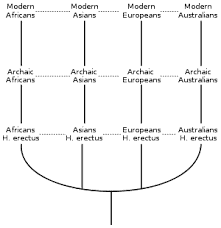
Meanwhile, an alternate model of human evolution, Multiregionalism or Regional Continuity, has gained traction, particularly in East Asia. According to multiregionalists, when H. erectus left Africa almost 2 million years ago, these early explorers didn’t die out. They fanned out across Eurasia and continued to evolve, eventually becoming regional populations of H. sapiens before other populations of H. sapiens left Africa. [Emphasis added.]
More:
The skull has some traits that are consistent with other archaic members of the genus Homo that have been found in East Asia…
“At about 300,000 years old, HLD 6 may be evidence of regional continuity, a transitional human that represents the evolution of archaic East Asian H. erectus populations into East Asian.”
From Science Alert:
What makes HLD-6 particularly compelling is its hybrid anatomy. The facial structure resembles modern humans, yet the absence of a chin is more Denisovan-like. Researchers from the Chinese Academy of Sciences, Xi’an Jiaotong University, and international collaborators suggest this fossil could represent a previously unidentified lineage—a hybrid between the branch that led to Homo sapiens and the one that produced Denisovans.
Working alongside researchers from China’s Xi’an Jiaotong University, the UK’s University of York, and Spain’s National Research Center on Human Evolution, researchers at CAS think they have uncovered an entirely new lineage – a hybrid between the branch that gave us modern humans and the branch that gave us other ancient hominins in the region, like Denisovans.
European Identitarians agree with the Chinese on multi-regional origins. Lucas Bourbon from France:
The theory of “African Eve” and “out of Africa” can now be placed within the radius of the dead ideologies… European men do not come from Africa.
HLD-6 Skull
Historically, many Pleistocene-era hominin fossils from China have defied easy classification. They’ve often been dismissed as primitive Homo sapiens or advanced Homo erectus. But HLD-6 doesn’t fit neatly into either category. Its unique traits suggest a lineage that diverged from Homo erectus around 750,000 years ago yet retained archaic features while developing modern ones.
Genomic studies have hinted at a fourth lineage of hominins in the Middle to Late Pleistocene, one that has remained elusive in the fossil record. HLD-6 may finally put a face to this missing branch, complicating—but also enriching—our understanding of human evolution.
As the multiregional model gains empirical support, the RAO hypothesis faces increasing scrutiny. The Hualongdong skull isn’t just a fossil—it’s a challenge to orthodoxy, a symbol of regional continuity, and perhaps a harbinger of a paradigm shift in paleoanthropology.
UPDATE!
The famous Dali skull is being reanalyzed and redated. There are some Chinese paleoanthropologists who now believe it should be taxonomically classified with Dragon Man – Homo longi from northeastern China.
Keywords: 直立, 人類進化化石發現, 甘肅 Hualongdong Skull