🦎 Tetrapod Tracks in Australia Rewrite Reptile Evolution by 40 Million Years
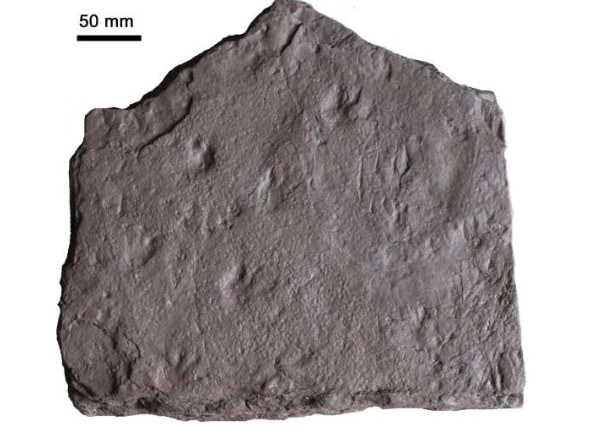
In a dried-out riverbed in northern Victoria, Australia, two weekend fossil hunters stumbled upon a discovery that would shake the foundations of evolutionary science. Craig Eury and John Eason—successful businessmen by weekday, amateur paleontologists by weekend—were indulging their harmless hobby when they unearthed a slab of sandstone that would turn the timeline of life on Earth upside down.
 They had initially inspired to take up fossil hunting by Professor John Long from Flinders University who came to speak on dinosaur fossils to their local library in Mansfield.
What they found were fossilized footprints—clawed, five-toed impressions etched into ancient rock. These weren’t just any tracks. They belonged to a primitive reptile-like creature that walked the Earth approximately 355 million years ago, during the early Carboniferous period, a time previously thought to be too early for such advanced land vertebrates.
These fossilized tetrapod tracks offer stunning evidence of early land vertebrates, pushing back the timeline of tetrapod evolution by 40 million years.
“These tracks are the oldest evidence of reptile-like animals walking on land anywhere in the world.” —John Long, Earth.com
🧬 The Devonian Legacy: Life Crawls Onto Land
 To understand the magnitude of this find, we need to rewind to the Devonian Period (419–359 million years ago), often dubbed the “Age of Fishes.” It was during this era that vertebrates began their tentative crawl from water to land. Transitional species like Tiktaalik—the so-called “fishapod”—marked the evolutionary bridge between aquatic and terrestrial life.
But until now, the fossil record suggested that amniotes—the group that includes reptiles, birds, and mammals—didn’t appear until the Late Carboniferous, around 318 million years ago. The tracks discovered by Eury and Eason push that timeline back by a staggering 35 to 40 million years, suggesting that reptile-like tetrapods were already roaming Gondwana while the Northern Hemisphere was still catching up.
🧪 Radiometric Dating: The Clock Beneath the Stone
The age of the tracks was confirmed using radiometric dating, a technique that measures the decay of isotopes in surrounding rock layers. The slab, part of the Snowy Plains Formation, was securely dated to the early Tournaisian, placing it at the very dawn of the Carboniferous era.
This method provides a scientific timestamp that’s virtually impossible to refute. It’s the same technique used to date volcanic eruptions, meteor impacts, and the age of the Earth itself. In this case, it confirms that clawed tetrapods—likely early sauropsids—were already adapted to terrestrial life far earlier than previously believed.
🧠 Challenging the Literal Timeline
 While the discovery is purely scientific, its implications ripple into cultural and ideological waters. The tracks directly contradict Young Earth Creationist claims that the planet is only 6,000 years old. These footprints, etched into stone hundreds of millions of years ago, offer tangible, empirical evidence of deep time—evidence that can be seen, touched, and measured.
For science educators, skeptics, and the broader Darwinian community, this find is more than a curiosity—it’s a myth-busting moment. It reinforces the power of the fossil record to illuminate Earth’s deep past and challenges narratives that reject geological and evolutionary evidence.
🦖 A Snapshot of Evolution in Motion
The creature that left these tracks was likely a small, stumpy, Goanna-like reptile, about 80 cm in length. Its clawed feet—distinct from amphibians—mark it as an early amniote, capable of surviving away from water. This adaptation was a critical evolutionary leap, allowing vertebrates to colonize dry land and eventually diversify into the vast array of species we see today.
Similar tracks have been found in Poland, suggesting that these early reptiles were not isolated to Gondwana but were evolving in parallel across multiple continents. This global footprint hints at a more rapid and complex evolutionary process than previously imagined.
🪨 The Power of Amateur Discovery
Perhaps the most poetic aspect of this story is its origin: two ordinary men, indulging a weekend hobby, stumbled upon a slab of stone that rewrote scientific history. Their find now resides in Museums Victoria, a testament to curiosity, persistence, and the idea that even the most unassuming explorers can uncover the secrets of Earth’s ancient past.
🌍 Final Thoughts: A Footprint in Time
This discovery doesn’t just add a new chapter to the story of reptile evolution—it rewrites the prologue. It reminds us that science is a living archive, constantly updated by new evidence and fresh eyes. And sometimes, those eyes belong not to seasoned academics, but to weekend wanderers with a passion for the past.
You can read the full scientific breakdown on .
More on bringing back extinct species to life. How far back could they go? Watch our Jurassic video.