Europe First in Math, evidence shows, Cut Marks on a Bone from Grăunceanu, Romania

Briana Pobiner
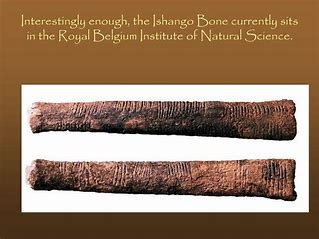
For decades, the Ishango Bone has stood as paleoanthropology’s sacred relic of cognition—a 22,000-year-old artifact from Central Africa etched with what many interpret as proto-mathematics. It’s been hailed as the earliest evidence of structured thought, geometric awareness, and symbolic reasoning. Some African scholars even mythologize it as “Wakanda’s Rosetta Stone,” a cultural emblem of intellectual primacy.
And it blows away the Africa Origins Only crowd. This new evidence shows Europe was first in math.
But what if that narrative is 2 million years late?
A recent discovery in Romania threatens to rewrite the entire timeline of symbolic cognition. Cut marks on ancient bones—dated to nearly 2 million years ago—suggest that early European hominins may have engaged in abstract reasoning long before the Ishango Bone was ever carved. These aren’t random scratches. They’re deliberate, structured, and possibly symbolic. If true, they represent one of the most provocative challenges to mainstream paleoanthropology in recent years.
From newswarner,
Tiny cut marks on animal bone fossils reveal that human ancestors were in Romania 1.95 million years ago
 A little background on Grăunceanu: This open-air site was originally excavated in the 1960s, and researchers found thousands of fossil animal bones there. It’s one of the best-known Early Pleistocene sites in East-Central Europe. Many of the fossil animal bones are quite complete and at the time of excavation lay together as they were positioned in life. The original deposition was called a “bone nest” because of how densely packed the bones were.
More from Yahoo News,
Tiny cut marks on animal bone fossils reveal that human ancestors were in Romania 1.95 million years ago
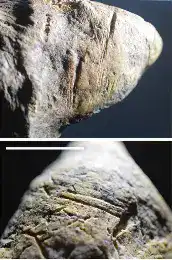 Based on our analyses, we determined that 20 Grăunceanu fossils are marked by cuts, with eight displaying high-confidence cut marks. Most of those marks are on fossils of hoofed animals, including a few deer; one is a small carnivore leg bone. When we could identify the type of bone, the cut marks are always in anatomical locations consistent with cutting meat off bones.
🧬 The Evidence: Romania’s Carved Bones
The site in question, nestled in the Carpathian region, yielded bone fragments bearing parallel incisions—regular, evenly spaced, and suggestive of intentional patterning. While some dismiss these marks as functional (butchery, tool sharpening, etc.), others argue they reflect geometric awareness. The spacing, orientation, and repetition hint at something deeper: symbolic cognition.
This isn’t just about tool use. It’s about the emergence of abstract thought. If these marks are intentional, they predate African symbolic artifacts by over a million years. That’s not a minor adjustment to the timeline—it’s a tectonic shift.
From DiscoverWildScience,
 To understand the implications of Grăunceanu, we must look east 1,500 kilometers away to the Dmanisi site in Georgia. Until recently, Dmanisi was considered the earliest confirmed evidence of hominins in Eurasia, dated between 1.85–1.78 million years ago. There, archaeologists uncovered not only butchered bones but five skulls of Homo erectus with startlingly small brains and surprisingly primitive physiques.
🔍 Comparative Context: Europe vs. Africa
The Ishango Bone, discovered near the headwaters of the Nile, has long been framed as the dawn of mathematical reasoning. Its tally marks are grouped in ways that suggest base-10 counting, prime numbers, and even lunar cycles. It’s elegant, mysterious, and undeniably symbolic.
But it’s also late.
Artifacts from the Levant—Manot, Qafzeh, and Quneitra caves—already challenge the notion that symbolic thought emerged solely in Africa. These sites, dated to 120,000–40,000 years ago, contain deliberate geometric engravings analyzed via 3D surface modeling to distinguish symbolic intent from functional wear. The Romanian find pushes that boundary back even further—into the realm of Homo erectus or even earlier European hominins.